

Every second phone call our shop gets about a new deck railing starts the same way: “We’re torn between wrought iron and glass.” It’s the default choice most architects and homeowners narrow down to, especially on the North Shore and West Vancouver where view is a major driver. The answer is almost never “one of these is objectively better” — the answer is almost always “which one fits the house, the view, and the life you want to live with it.” Here’s the honest comparison.
What each option actually is in 2026
A few definitions to start, because the terms get used loosely.
“Wrought iron” in 2026 practice is almost always hand-forged or welded mild steel shaped to look like traditional wrought iron. Real wrought iron hasn’t been manufactured commercially since 1973. Modern “wrought iron” railings are either welded steel fabrications (most new residential work) or hand-forged mild steel for heritage-style projects. We covered the distinction in forged vs. welded ironwork.
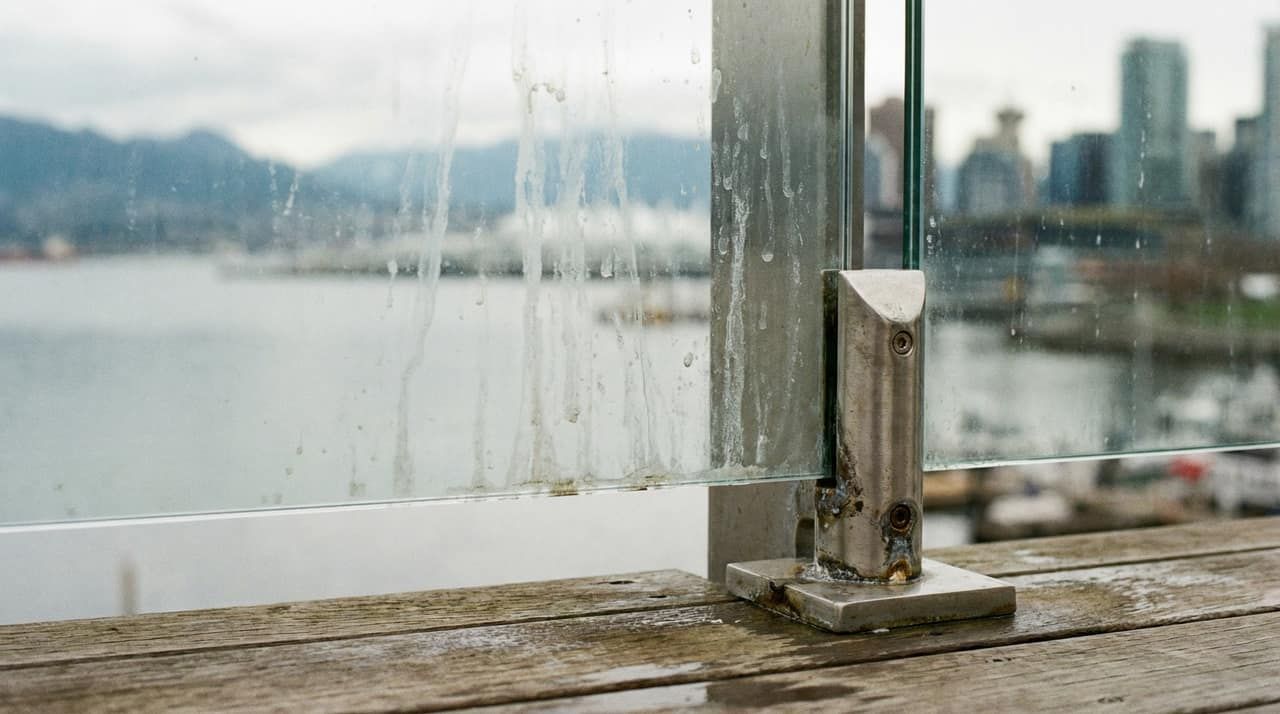
Frameless glass railings are tempered or tempered-laminated glass panels mounted with either spigots (stainless steel posts bolted to the deck), structural channels (a continuous aluminum or stainless U-channel at the base), or standoffs (hardware set into the deck edge). No vertical posts between panels in the frameless version, which is where the “uninterrupted view” look comes from.
Semi-frameless / post-and-glass hybrids combine traditional posts with glass infill between. Cheaper, less visually open, easier to repair.
View, character, and the first-order decision
On any view property on Vancouver’s North Shore, the West Side, West Vancouver, or Squamish, the primary reason clients pick glass is that they don’t want to filter the view. A chair-height seating position looking at Burrard Inlet through frameless glass is almost visually identical to having no railing at all. Wrought iron at the same position will block 30–40% of the sight line even with 4 in picket spacing.
On a Shaughnessy, Mount Pleasant, or West End character home, the primary reason clients pick wrought iron is that nothing else looks right. A frameless glass railing on a 1910 Edwardian porch reads as a mistake from twenty feet away. The architectural language of the house demands the material and the profile — see our heritage ironwork restoration guide for how that logic plays out on the heritage side.
When the property doesn’t make the choice for you — a modern Burnaby build, a midcentury Kitsilano bungalow, a new North Vancouver custom home — the decision comes down to cost, maintenance, and how you want to live with the railing.
What each option costs in 2026
Real Metro Vancouver numbers from recent residential projects:
Wrought iron / welded steel:
- Modern welded mild steel with powder coat, square tube posts and picket infill — $250–$450 per linear foot installed
- Welded steel with light forged detail (twists, finials) — $350–$550 per linear foot
- Hand-forged heritage-style railing with scrolls and period detailing — $500–$900+ per linear foot
- Duplex-finished (galvanized + powder coat) for coastal use — add $8–$15 per linear foot
Frameless glass:
- Spigot-mount frameless, 12 mm tempered glass, aluminum or 304 hardware — $400–$650 per linear foot
- Spigot-mount frameless, 13.52 mm tempered laminated, 316L stainless hardware — $550–$900 per linear foot
- Channel-mount frameless with continuous base channel — $600–$1,000 per linear foot
- Standoff-mount frameless with engineered point fixings — $700–$1,200 per linear foot
Hybrid iron-and-glass — $400–$750 per linear foot depending on post spacing and glass grade.
For a typical 60 ft Vancouver deck railing, the cost delta between a quality welded steel railing ($350 × 60 = $21,000) and a quality frameless glass system ($650 × 60 = $39,000) is roughly $18,000 — meaningful, but often the difference between a million-dollar view being visible or not.
Maintenance and life cycle — the numbers that surprise people
This is the part of the conversation most clients haven’t thought about. Here’s what actually happens over 20 years:
Wrought iron maintenance:
- Year 1–10: nothing beyond occasional wash
- Year 10–15: first refinishing — light sand, primer, and topcoat, typically $25–$60 per linear foot depending on design complexity
- Year 15–20: possible hardware service (check fasteners, re-touch finish)
- Year 20+: full refinishing cycle, $40–$100 per linear foot
Total 20-year maintenance cost on a 60 ft iron railing: roughly $3,000–$8,000.
Glass maintenance:
- Ongoing: cleaning every 4–6 weeks in rainy season, weekly in coastal spray zones — either homeowner time or ~$300–$600 per year with a window cleaning service
- Year 10–15: hardware service (spigots, brackets, gaskets)
- Year 15–25: possible panel replacement if any break or delaminate — tempered laminated glass panels are typically $400–$900 each for a standard deck size
- Year 20+: full hardware refurbishment or partial replacement
Total 20-year maintenance cost on a 60 ft glass railing: roughly $6,000–$14,000, mostly in cleaning labour.
The takeaway: over a long horizon, glass is higher maintenance than iron, not lower. The perception runs the other way because iron “looks like work” and glass “looks like no work,” but the math favours iron for passive owners.
Code, safety, and the load requirements
Both systems meet the BC Building Code’s Section 9.8.8 residential guard requirements when properly specified:
- Minimum height — 915 mm (36 in) for decks under 1.8 m, 1,070 mm (42 in) above
- Horizontal load — 0.75 kN/m (51 lb/ft)
- Point load — 1.0 kN (225 lb) at any location
- 100 mm sphere rule — no opening in the guard infill that lets a 100 mm sphere pass
Glass railings need engineered hardware matched to the glass thickness. Most Metro Vancouver glass railing systems use 12 mm tempered or 13.52 mm tempered-laminated glass. The laminated version is safer because it holds together when broken — we specify it by default on any deck where a broken pane could fall onto a walkway or neighbour’s yard below.
Wrought iron needs climb-resistant design when the guard is more than 4.2 m above adjacent grade — no horizontal elements between 140 mm and 900 mm above the walking surface that would act like a ladder. This catches a lot of designers who want horizontal bar infill on high balconies. See our BC Building Code railing requirements breakdown for the full detail.
Where the hybrid option wins
Many of our Metro Vancouver clients end up on the hybrid path: welded steel top rail and posts with frameless glass infill between. The posts handle the load, the glass provides the view, and the system reads as cleaner than a full picket railing. Typical cost: $400–$750 per linear foot, depending on post spacing and glass spec.
The hybrid is especially good for:
- North Vancouver and West Vancouver view homes where the view matters but full frameless feels too modern
- Heritage-adjacent homes in Mount Pleasant or Kerrisdale where a simple steel frame reads as period-appropriate
- Structural spans where full frameless glass would require engineering the deck edge for specific point loads
How to actually decide
The questions we ask every client at our Burnaby shop when they’re debating iron vs. glass:
- How important is the view from a seated position? If it’s the whole reason you bought the house, glass wins
- What’s the architectural era of the home? Heritage → iron. Modern → either. Contemporary → glass
- Will you or someone else clean the railing regularly? If nobody wants to clean, iron is lower ongoing effort
- Is the deck in a splash zone or exposed waterfront? Both systems can handle it with the right spec — see marine-grade metalwork
- Does the budget have room for both materials? If the answer is no, decide which one you’d resent more in year 10
Most projects decide in that order, and about half end up on the hybrid path once the trade-offs are clear.
For broader railing guidance, see the guide to custom railings in Vancouver. If you’re scoping a railing project for a Metro Vancouver home and want to see examples of both systems in person, the Burnaby shop has samples of welded iron, hand-forged iron, and three different glass mounting systems on the floor — bring your drawings or photos and we’ll walk you through them.

