

We get calls every week from homeowners and contractors who are partway through a project with a fabricator and something has gone sideways. The shop drawings don’t match what was discussed. The timeline has slipped twice. The finish looks nothing like the sample. Or the welds failed inspection and now the whole schedule is blown.
Most of these problems trace back to the same root cause: the wrong questions were asked at the start — or no questions were asked at all. Picking a metal fabrication shop in Metro Vancouver isn’t like choosing a painter or a plumber. The work is structural, permanent, and expensive to redo. A bad choice doesn’t just cost money. It costs months.
Here are the 10 questions we’d ask if we were hiring a fabricator for our own project.
1. Are you C.W.B. certified — and to what division?
This is the first question. Not “do you have a nice website” or “can you match this Pinterest photo.” Canadian Welding Bureau certification to CSA W47.1 standards means the shop’s welding procedures have been tested, their welders are qualified, and the whole operation is subject to regular audit.
But C.W.B. certification has divisions. Division 1 covers structural steel — beams, columns, moment connections, anything that carries load. Division 2 covers steel construction (bridges, pressure vessels). Division 3 covers reinforcing steel. If your project involves a structural staircase or load-bearing steel frame, you need a Division 1 shop. An ornamental-only certification won’t cut it for structural work, and in BC, the building inspector can (and will) ask for documentation.
Ask for the certificate number. Then verify it on the C.W.B. website. It takes two minutes.
2. What does your liability insurance cover — and how much?
Every legitimate fabrication shop carries commercial general liability. But the numbers matter. A shop with $1 million in CGL coverage is fine for a residential railing. A $500,000 structural steel package on a commercial build? That needs $5 million minimum, and the GC will ask for a certificate of insurance naming them as additionally insured before the shop sets foot on site.
Also ask about completed operations coverage. Standard CGL covers damage during the work. Completed operations covers problems that show up after installation — a weld that fails six months later, a connection that wasn’t properly torqued. If the shop gives you a blank look when you ask about completed operations, that tells you something.
3. Can I see three recent projects similar to mine?
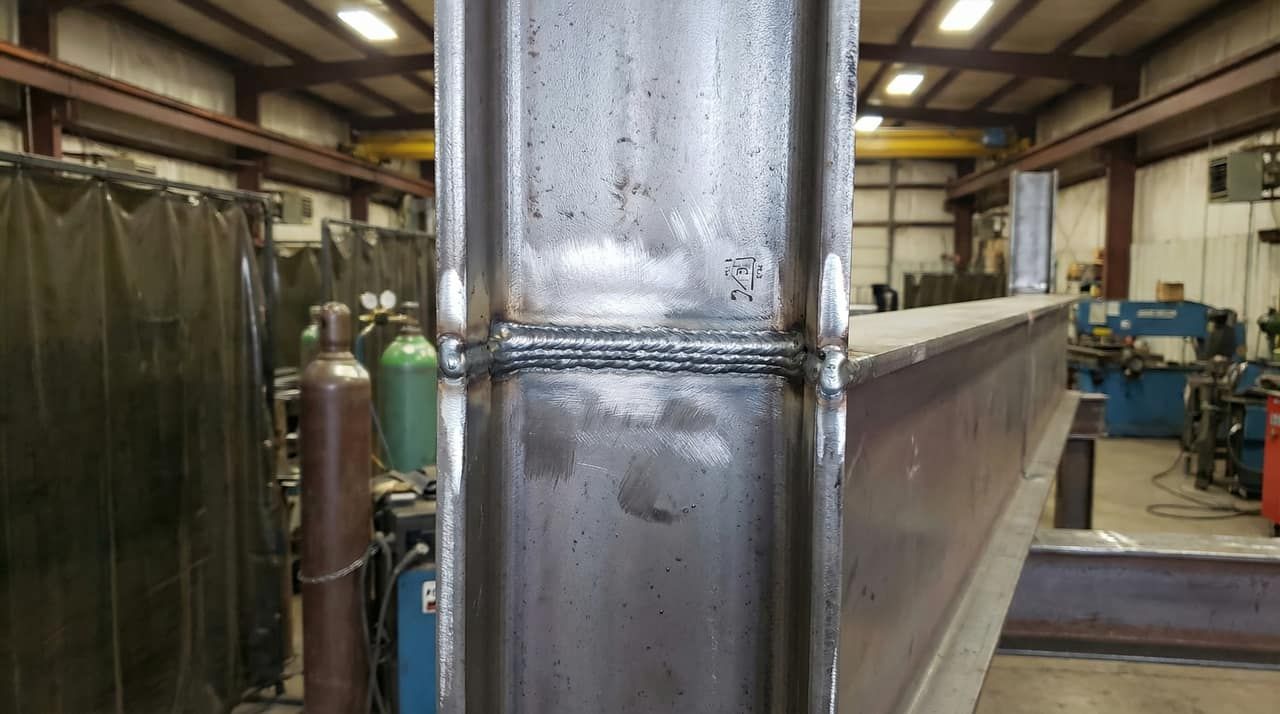
Portfolio photos on a website are a start, but they’re curated. What you want are references from projects that match your scope — not just “we do stairs” but “we did a mono stringer floating staircase in a 1960s East Vancouver character home with limited access and a tight timeline.”
Ask for the project address (or at least the city), the scope, and a contact — the homeowner, the architect, or the GC. A shop that’s proud of their work will hand this over without hesitation. A shop that can’t produce three references for work similar to yours either hasn’t done it or doesn’t want you talking to past clients. Both are problems.
When you call the reference, ask one question above all: did the final product match the shop drawings? That single answer tells you almost everything about how a shop operates.
4. What’s your shop drawing process?
Shop drawings are the blueprint for fabrication. They show every dimension, every connection detail, every weld callout, every finish specification. On a custom staircase, the shop drawings define tread depth, riser height, stringer profile, mounting connection to the structural slab or framing, and guardrail attachment.
A good shop produces detailed drawings in CAD (most use SolidWorks, AutoCAD, or Tekla) and sends them to you for written approval before cutting a single piece of steel. Changes at the drawing stage cost nothing. Changes after fabrication starts cost thousands.
The red flag here is a shop that says “we’ll figure it out on site” or “we don’t usually do formal drawings for residential work.” That approach works for a simple handrail bracket. It does not work for a $25,000 staircase or a structural steel package on a new Burnaby build. If the shop won’t produce proper drawings, they’re not the shop for the job.
5. Where do you source your steel — and what grade?
This question catches more shops off guard than you’d expect. Steel comes in grades, and the grade matters. Most custom fabrication in Metro Vancouver uses CSA G40.21 Grade 300W or 350W for structural applications, and ASTM A36 or A500 for miscellaneous metals and hollow structural sections.
Ask where the steel comes from. A shop buying from a reputable Canadian service centre (Russel Metals, Samuel Son, Specialty Metals) is getting material with proper mill certs and traceability. A shop buying mystery steel from an overseas supplier or salvage yard might save on material cost — but you won’t have documentation if an inspector asks, and the material properties could be inconsistent.
For stainless steel projects (exterior railings in West Vancouver, waterfront work, food-grade applications), make sure the shop specifies 304 or 316 grade. “Stainless” without a grade number is meaningless. Grade 316 costs more but resists salt air and chloride exposure — worth the premium on any North Shore waterfront property.
6. What finish options do you offer in-house vs. subcontracted?
Finishing is where a lot of fabrication projects go wrong. Powder coating, hot-dip galvanizing, patina finishes, brushed stainless — each requires different equipment and expertise. Most fabrication shops don’t do all of these in-house.
That’s fine. What matters is whether the shop manages the finishing process or hands you a bare steel product and says “find a powder coater.” A shop that coordinates finishing as part of the scope controls quality and timeline. A shop that doesn’t means you’re managing another trade, another schedule, and another potential failure point.
Specific questions to ask: Do you have an in-house powder coat line, or do you sub it out? If subcontracted, who’s your coater and what’s their turnaround? For exterior steel in Vancouver’s climate, do you galvanize before powder coating? (The answer should be yes for any steel that sees rain.) What’s the coating warranty — and is it the shop’s warranty or the coating manufacturer’s?
A single-colour powder coat in matte black or grey typically adds $8–$15 per linear foot. Hot-dip galvanizing runs $12–$25 per foot. Specialty finishes — metallic bronze, textured hammered coat, Corten weathering steel — add more and require specific expertise.
7. Do you guarantee your timeline — and what happens when you miss it?
Every shop will tell you “6–8 weeks” at the quote stage. The question is what happens at week 10 when the steel isn’t ready and the GC has scheduled the next trade to start.
Get the timeline in writing. Not a verbal estimate — a schedule with milestones: shop drawing approval by X date, fabrication complete by Y date, installation by Z date. And ask what the consequence is if they miss it. On commercial projects, liquidated damages clauses are standard. On residential work, they’re rare, but a shop that refuses to put any timeline commitment in writing is telling you something about their backlog management.
At our Burnaby shop, we build schedule buffer into our quotes because we know what causes delays: late approvals on shop drawings (the most common), site not ready for install, finish subcontractor backlogs. We’d rather quote 8 weeks and deliver in 7 than quote 5 and deliver in 9.
8. Who installs — your crew or a subcontractor?
This matters more than most people realize. The crew that fabricated the steel knows every connection, every tight tolerance, every field-weld location. A third-party installer is working from drawings and guessing at intent.
Ask whether the installation crew are employees of the shop or subcontracted. Ask if the lead installer was involved in the fabrication. On structural work, ask if the field welder holds the same C.W.B. qualifications as the shop welders — because field welds are inspected to the same standard.
We’ve picked up projects where a different shop fabricated the steel but couldn’t (or wouldn’t) install it. Fitting someone else’s fabrication is almost always harder than fitting your own. Dimensions that were supposed to be exact are off by 10mm. Holes that should align don’t. Field modifications eat hours. If the fabricator and installer are the same company, accountability is clear and the work goes faster.
9. What warranty do you provide — and what does it actually cover?
“We stand behind our work” is not a warranty. Get specifics. A written warranty should cover:
Structural integrity — the welds and connections won’t fail under normal loading conditions. This should be at least 10 years for structural steel and 5 years minimum for railings and misc. metals.
Finish — how long before the powder coat fades, chips, or peels? Most reputable powder coaters warranty against peeling and significant fading for 5–10 years on exterior applications. Interior finishes should hold up longer.
Installation — anchors, base plates, and fasteners. If a mounting bolt loosens or a base plate connection fails within a reasonable period, the shop should come back and fix it at no charge.
What the warranty probably won’t cover: damage from other trades, modifications made after installation, normal wear on high-traffic surfaces, or failure caused by improper maintenance (like never cleaning salt spray off stainless cable railing hardware on a waterfront deck). That’s fair — but make sure it’s spelled out.
10. Can I visit the shop?
This is the question that separates serious fabricators from brokers. A broker takes your order, subs the work to an unknown shop (sometimes overseas), marks it up, and delivers. They might have a nice office and a polished website, but they don’t own a plasma cutter.
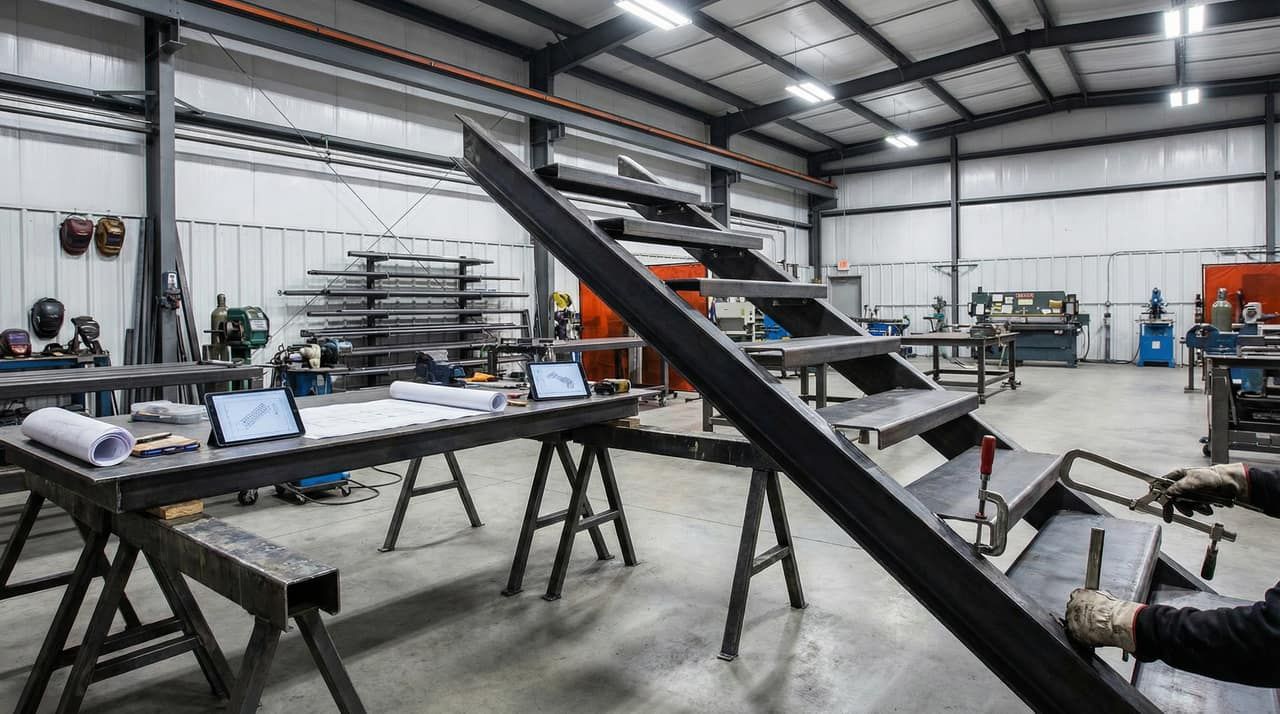
A real fabrication shop will invite you in. You’ll see the equipment — a plasma table or waterjet, welding stations, a grinding area, a paint booth or prep area. You’ll see work in progress. You’ll see safety equipment, organized material storage, and a workflow that makes sense.
Our shop at 2544 Douglas Road in Burnaby is open for client visits. We walk architects and homeowners through active projects so they can see what their steel will look like at each stage — raw cut, welded, ground, finished. It takes 20 minutes and it answers more questions than a phone call ever could.
The cost of asking the wrong shop
A structural staircase that needs to be refabricated costs $15,000–$30,000 the second time — plus demolition, disposal, and the schedule damage to every trade behind it. A railing that fails inspection holds up occupancy permits. A finish that peels after one Vancouver winter means stripping, re-prepping, and recoating at $2,000–$5,000 depending on the scope.
These aren’t hypothetical numbers. We’ve quoted remediation work on all of these scenarios for clients in Burnaby, Vancouver, and New Westminster who hired the lowest bidder the first time.
The 10 questions above take 30 minutes to ask and a few days to verify. That’s a small investment against a project budget that could run anywhere from $5,000 for a railing system to $100,000+ for a structural steel package on a commercial build.
If you want to run through these questions with our team, request a quote or visit our Burnaby shop — we’ll answer every one of them and show you the certifications, the insurance, the equipment, and the work in progress to back it up.

