

Metro Vancouver homeowners, architects, and contractors specify custom railings more often than any other single metalwork item. We fabricate and install every type — steel picket, cable, glass-and-metal, aluminum, stainless, ornamental iron — from our C.W.B. certified shop in Burnaby, and the questions we field tend to follow the same pattern. What style works best for this building? What does it actually cost? Will it pass inspection?
This guide covers all of it: the six main railing types we build, what each one costs installed in 2026, BC Building Code requirements that constrain your design, and the material decisions that determine how your railing performs in Vancouver’s rain and coastal air.
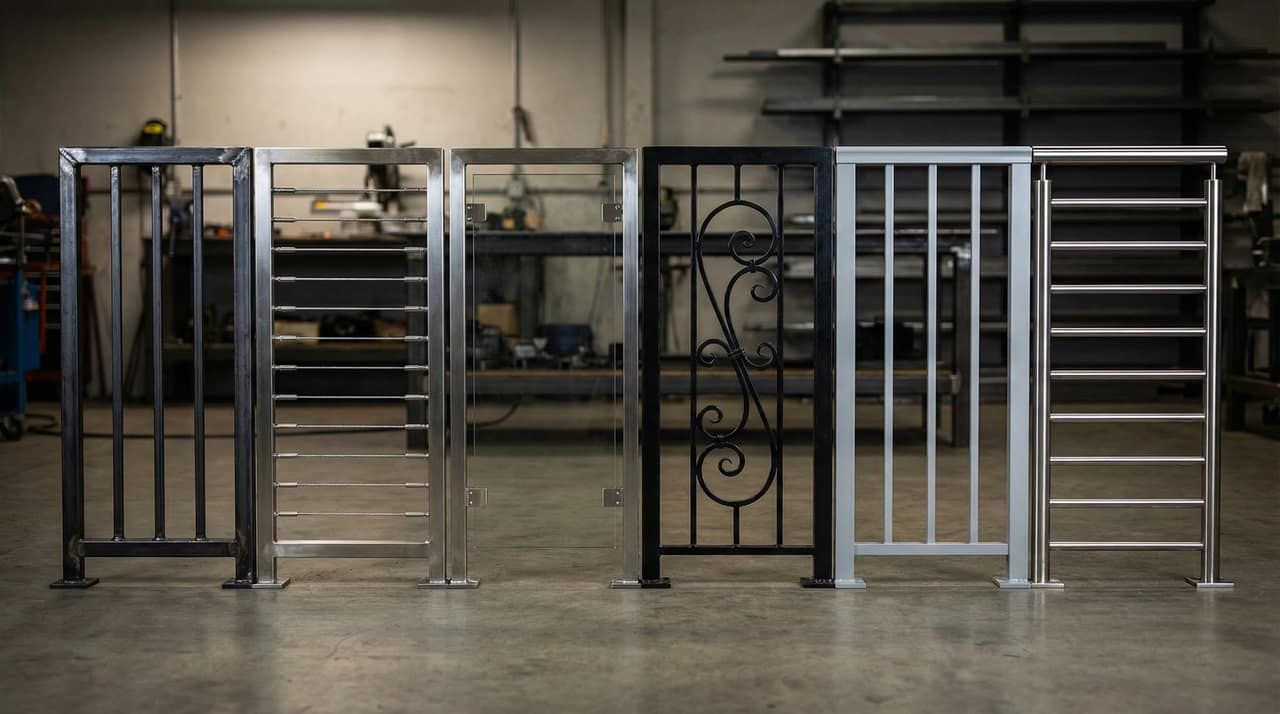
The six railing types we fabricate
Not every railing style suits every project. The right choice depends on the building, the budget, the sightline requirements, and whether the railing lives indoors or faces eight months of rain.
Steel picket railings are the standard for residential and light commercial work across Burnaby, New Westminster, and East Vancouver. Vertical steel bars welded into a steel frame, powder coated in matte black or a custom colour. They’re strong, code-compliant with standard 4-inch picket spacing, and visually clean. This is what most builders default to — and for good reason.
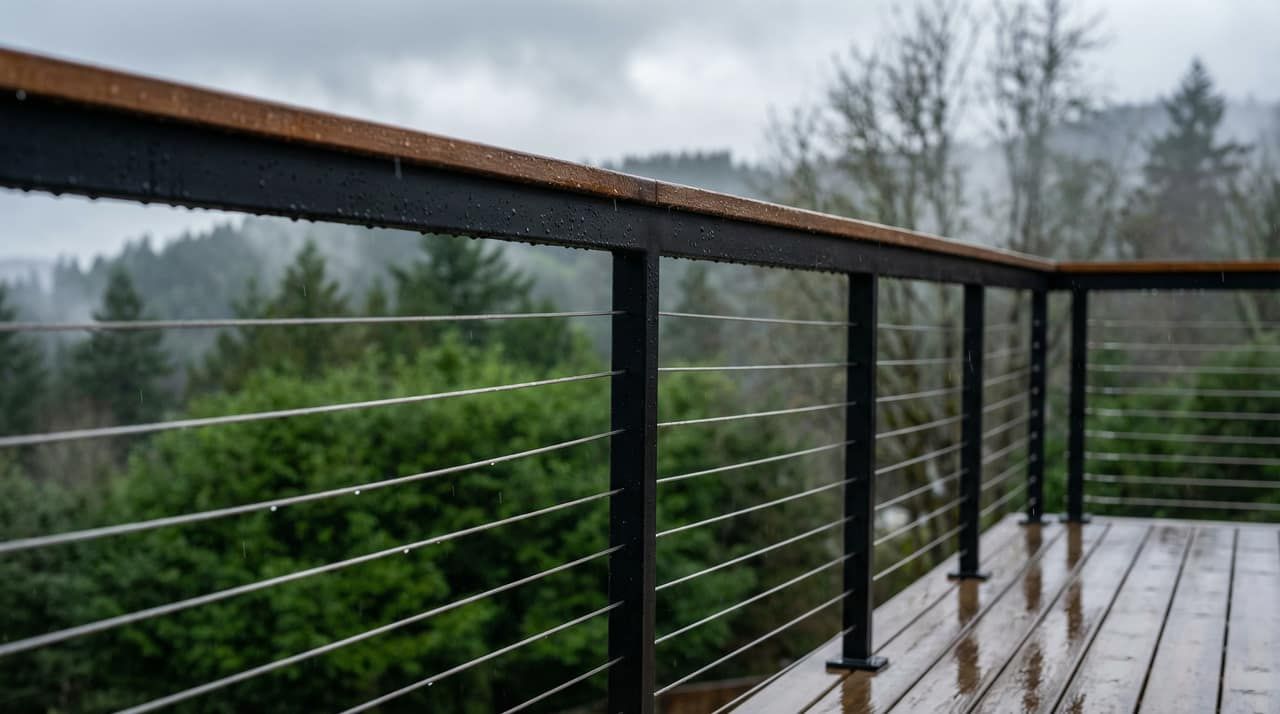
Cable railing systems use steel posts (mild steel or stainless) with horizontal stainless steel cables as infill. The cables preserve sightlines without the cost of glass. Popular on North Shore custom homes and newer Coquitlam builds where architects want an open feel. The cables themselves aren’t the expensive part — post fabrication and tensioning hardware drive the cost.
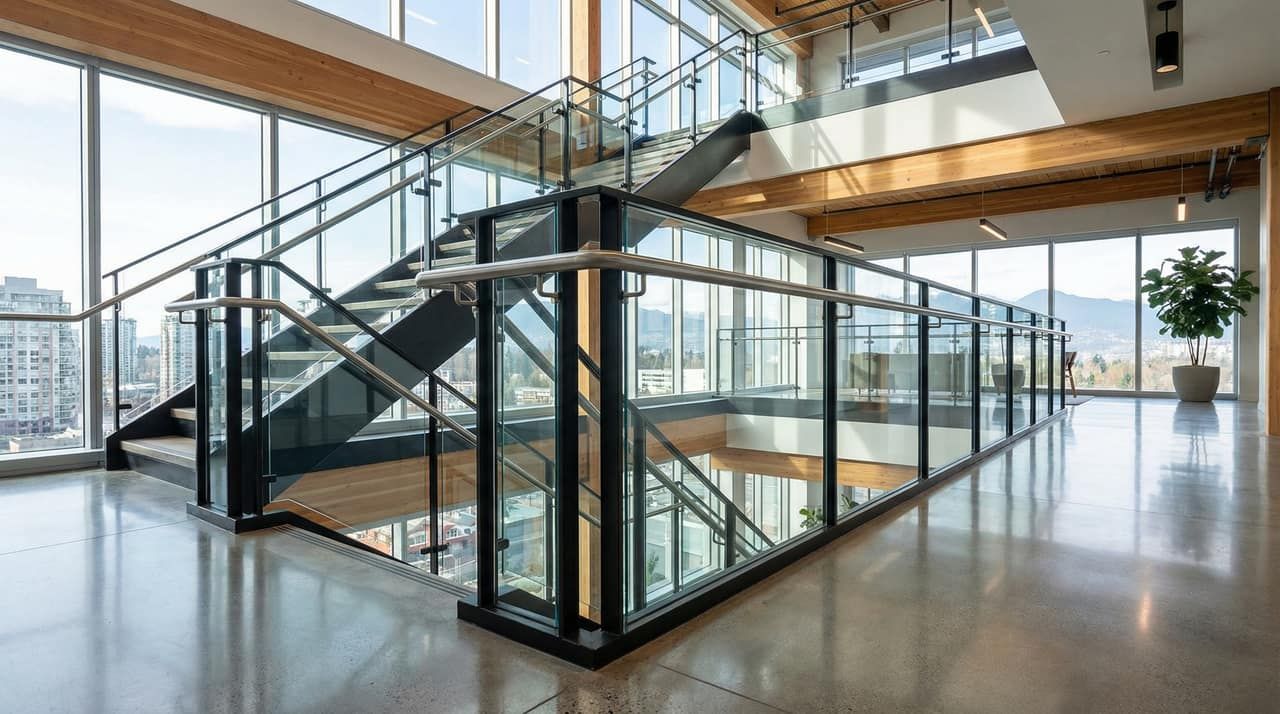
Glass-and-metal hybrid railings pair steel or aluminum posts with tempered glass panels. Semi-frameless versions use an aluminum base channel; fully frameless systems rely on standoff hardware or point-fixed connections. This is the premium option for waterfront properties and modern West Vancouver and downtown condo lobbies. Glass panels need to be 12mm tempered minimum for guardrail applications, and curved glass adds roughly 50% to the panel cost.
Aluminum railings are the lightest and most corrosion-resistant metal option. Prefabricated aluminum panel systems are the budget entry point. Custom aluminum — thicker extrusions, welded connections, colour-matched powder coat — pushes higher but still undercuts steel on material cost. The trade-off is strength: aluminum flexes more under load and dents more easily than steel. For a deeper comparison, see our post on steel vs aluminum railings in Vancouver.
Stainless steel railings use 304 or 316 grade stainless for posts, rails, and sometimes the infill. Grade 316 is the marine standard — it handles salt air without pitting. We use it on waterfront projects along the North Shore and for commercial exterior applications where the client wants zero maintenance for 20+ years. The material costs 2–3x more than mild steel, and it’s harder to weld cleanly, so the fabrication hours run higher too.
Wrought iron and ornamental steel railings feature forged details — scrolls, twists, rosettes, collars — that reference traditional blacksmithing. We see demand for this style on character home restorations in Kitsilano and Mount Pleasant, heritage projects, and custom gates. Each ornamental element is hand-formed, which means more shop hours per linear foot than any other style.
What each railing type costs installed
These are 2026 installed prices across Metro Vancouver — material, fabrication, finishing, and installation included. For a more detailed cost breakdown with project examples, see our railing cost guide.
| Railing type | Installed cost per linear foot | Best for |
|---|---|---|
| Aluminum (prefab panels) | $60–$90 | Budget deck railings, rental properties |
| Aluminum (custom welded) | $120–$150 | Mid-range decks, balconies |
| Steel picket | $120–$200 | Residential decks, staircases, balconies |
| Wrought iron / ornamental | $130–$250 | Character homes, heritage restoration |
| Cable railing | $150–$275 | Modern homes, sightline-sensitive locations |
| Glass-and-metal (semi-frameless) | $200–$300 | Contemporary homes, covered decks |
| Glass-and-metal (frameless) | $300–$400+ | Waterfront homes, commercial lobbies |
| Stainless steel (316 grade) | $250–$400 | Marine environments, zero-maintenance specs |
These ranges assume a straight level run. Staircase sections, curves, and unusual mounting conditions push toward the high end — or beyond it.
BC Building Code requirements that shape every railing design
The BC Building Code doesn’t leave much room for creative interpretation on guards and railings. Every custom railing we fabricate has to meet these requirements, and inspectors in Burnaby, Vancouver, and across Metro Vancouver check them. For a full breakdown of code requirements, see our BC Building Code railing post.
When you need a guard. Any walking surface more than 600mm (24 inches) above the adjacent surface or grade requires a guard. That includes decks, balconies, mezzanines, stairs with more than two risers, and rooftop patios.
Height minimums. Within a single dwelling unit where the drop is under 1.8m, the minimum guard height is 900mm (about 36 inches). Above 1.8m, or in any multi-unit residential or commercial application, the minimum is 1,070mm (42 inches). These are measured from the walking surface to the top of the guard — not the handrail cap, unless the handrail serves as the top of the guard.
The 100mm sphere test. No opening in the guard can allow a 100mm (4-inch) sphere to pass through. This governs picket spacing, cable spacing, glass panel gaps, and any decorative pattern. It’s the child-safety rule, and it’s non-negotiable. On steel picket railings, that translates to roughly 3.5-inch clear spacing between bars. On cable railings, cables need to be spaced at about 75–80mm on centre.
No climbable elements. Between 100mm and 900mm above the floor, the guard can’t have elements that create a climbing foothold. Horizontal bars spaced like a ladder are the classic violation. Horizontal cable railings are now permitted in BC for fall heights up to 4.2m, but the spacing must meet the sphere test and the cables need to maintain tension under load.
Structural load requirements. Guards must resist specific loads: a concentrated load of 1.0 kN applied at the top, and a uniform load of 0.75 kN/m along the top rail. Commercial and assembly occupancies have higher load requirements. Glass panel guards have additional requirements under CSA A500 for safety glazing.
These aren’t optional items to address later. They need to be designed in from the start. A railing that looks great but fails the sphere test or sits 20mm too short is coming down and getting rebuilt.
Material selection for Vancouver’s climate
Vancouver gets about 1,200mm of rain annually, the air carries salt from the coast, and summer UV is strong enough to fade cheap finishes within a few seasons. Material choice has to account for all three.
Mild steel is the most common material for custom railings. It’s strong, weldable, and cost-effective. But it rusts. In Vancouver’s wet climate, bare mild steel can show visible corrosion at weld joints within a single winter. The solution is proper finishing: hot-dip galvanizing creates a zinc barrier, and powder coating over the galvanizing adds colour and UV protection. A galvanized-and-powder-coated steel railing will last 20–30 years in Metro Vancouver with minimal maintenance.
Stainless steel (316 grade) is the premium choice for corrosion resistance. It handles salt air, rain, and UV without any coating at all. We specify it for waterfront properties and any exterior application where the client doesn’t want to think about maintenance for decades. The cost is roughly 2–3x the material price of mild steel, and fabrication takes longer because stainless requires different welding techniques and careful post-weld cleaning to maintain its corrosion resistance.
Aluminum is naturally corrosion-resistant — it forms its own oxide layer that prevents further degradation. It’s lighter than steel (about one-third the weight), which makes it easier to handle during installation. The weakness is structural: aluminum is softer and more flexible than steel. A steel post that needs to be 2x2 inches might need to be 2.5x2.5 in aluminum to achieve the same rigidity. Powder coating adheres well to aluminum and adds colour without affecting corrosion performance.
For a full comparison of how steel and aluminum hold up in Metro Vancouver conditions, read our steel vs aluminum railings analysis.
Tempered glass panels in railing applications are typically 12mm thick and must meet CSA A500 safety glazing standards. Glass doesn’t corrode, but it does require cleaning — mineral deposits from Vancouver’s rain leave visible water spots on exterior glass panels, especially on south-facing exposures. Frameless glass systems need regular inspection of standoff hardware and gaskets to make sure nothing loosens over time.
Interior vs exterior: different problems, different solutions
Interior railings have it easy. No rain, no UV, no salt air. A standard powder coat finish on mild steel will hold up for the life of the building. Mounting is usually into wood framing — floor joists, stud walls, stair stringers — which means straightforward base plate connections with lag bolts.
Exterior railings in Metro Vancouver face a different set of conditions. Rain exposure means every horizontal surface collects water, and every joint where two pieces of steel meet creates a potential corrosion point. Hot-dip galvanizing before powder coating is the minimum standard for exterior mild steel. Some fabricators skip the galvanizing and just powder coat — that works fine in Arizona, but in Vancouver, you’re likely to see rust bleed at weld joints and connection points within 3–5 years.
Mounting conditions also differ. Exterior railings often anchor into concrete — balcony slabs, concrete porch decks, retaining walls — which requires concrete anchoring hardware and sometimes core drilling. Interior mounting into wood framing is faster and less expensive.
Budget an extra $15–$40 per linear foot for exterior applications compared to the same design used indoors. That premium covers galvanizing, upgraded hardware, and the additional installation time for concrete-mounted connections.
Finish options and how long they last
The finish on a metal railing does two jobs: it looks good, and it protects the steel from corrosion. In Vancouver, the protection part matters more than most cities. For a detailed comparison of finish systems, see our powder coating vs paint vs galvanizing guide.
Powder coating is the standard finish for custom metalwork. A dry powder is applied electrostatically and heat-cured in an oven, creating a hard, even coating that resists chipping better than wet paint. Standard single-colour powder coat adds $8–$15 per linear foot. Specialty finishes — metallic bronze, textured hammered coat, two-tone colour — run higher. Interior powder coat lasts indefinitely with normal use. Exterior, expect 10–15 years before colour fading becomes noticeable, longer in shaded locations.
Hot-dip galvanizing submerges the fabricated steel in molten zinc at about 450 degrees Celsius. The zinc bonds metallurgically to the steel surface, creating a sacrificial barrier — the zinc corrodes instead of the steel underneath. Galvanizing adds $12–$25 per linear foot and extends the life of exterior steel by 20–30 years in Metro Vancouver’s climate. The raw galvanized look is industrial-grey; most residential clients opt for powder coating over the galvanized surface for a finished appearance.
Galvanize-plus-powder-coat is the gold standard for exterior steel railings in Vancouver. The galvanizing provides the corrosion barrier, the powder coat adds colour and UV protection. Even if the powder coat chips or wears through in a spot, the zinc layer underneath prevents rust from starting. We specify this combination on every exterior mild steel railing we fabricate.
Brushed or polished stainless steel needs no coating. A #4 brushed finish hides fingerprints and minor scratches. Mirror polish (which we rarely recommend for railings) shows everything. Stainless steel in a rain-exposed location will develop water spotting and needs periodic cleaning with a stainless-specific cleaner to maintain its appearance — but it won’t corrode.
Why staircase railings cost 25–40% more
A straight 30-foot deck railing uses identical posts, identical infill panels, and one consistent height along the entire run. The shop drawings are simple. Fabrication is repetitive. Installation is fast.
Staircase railings break every one of those efficiencies. Post heights change at each tread. The top rail follows the stair pitch — and if the staircase has a landing, the rail transitions from angled to level and back again. Infill panels become parallelograms instead of rectangles. On a cable railing, every cable passes through posts at a different height and angle, which means every penetration is laid out individually rather than on a repeating template.
We recently fabricated a staircase balustrade for a three-storey Burnaby home that transitioned from a straight level run on the upper hallway, down a curved staircase to the main floor, through a landing, and continued down to the basement. Four different geometries, three different railing heights (900mm on the upper floor, 1,070mm at the open stairwell), and about 65 linear feet total. The shop drawing package alone took three days — a straight deck railing of the same length would have been done in half a day.
That extra design, fabrication, and installation time is where the 25–40% premium comes from. It’s not a markup — it’s real hours.
Commercial vs residential railing requirements
Residential railings in a single dwelling unit follow the prescriptive path in Part 9 of the BC Building Code. The requirements are straightforward: minimum heights, sphere test, load ratings, and non-climbable design. Most residential railings don’t need an engineer’s stamp as long as they meet the prescriptive standards.
Commercial and multi-unit residential projects are different. Part 3 of the code applies, with higher load requirements, more stringent fire separation rules (relevant when railings are near rated assemblies), and often a requirement for sealed engineering drawings. Assembly occupancies — restaurants, retail spaces, theatres — have the highest guard load requirements.
Commercial railing projects also involve more coordination. The railing fabricator works within the general contractor’s schedule, responds to RFIs from the architect, produces shop drawings that get reviewed by the engineer of record, and installs around other trades. The timeline is less predictable, and the documentation requirements add overhead.
Pricing reflects this. Commercial railing work typically runs 15–25% higher per linear foot than equivalent residential work, even with the same material and design. The difference is engineering, coordination, and documentation — not steel.
How to spec railings for architects
If you’re an architect or designer specifying custom railings on a Metro Vancouver project, here’s what we need to produce accurate shop drawings and pricing.
Material and finish. Steel, stainless, aluminum, or mixed. Powder coat colour (RAL number or colour-matched sample). Galvanizing requirements for exterior applications.
Infill type. Picket (vertical bar), cable, glass, ornamental, or mixed. For glass, specify whether semi-frameless (base channel) or frameless (standoffs/point-fixed), and whether the glass is clear, tinted, frosted, or low-iron.
Dimensions. Top-of-rail height, post spacing (or “to suit” if you’re flexible), post profile (square tube, round pipe, flat bar), and top rail profile (cap rail, flat bar, wood cap, or continuous graspable handrail). For stairs, provide the rise, run, and finished floor elevations at each level.
Mounting conditions. What are the posts anchoring into? Concrete slab, wood framing, steel structure, masonry? Side-mounted (fascia) or top-mounted (surface)? This affects base plate design, anchor specification, and installation method.
Code path. Part 9 residential or Part 3 commercial? Is an engineer’s stamp required? If yes, we coordinate with a structural engineer to produce sealed drawings — but we need to know that upfront so the engineering fee is included in the quote.
Coordination notes. Are other trades working in the same area? Is there a floor finish going in after railing installation (which affects post height)? Will the railing be installed before or after drywall? These details prevent field conflicts and change orders.
The more complete the specification, the tighter the quote. A one-line callout on a drawing that says “metal railing — TBD” gives us almost nothing to price. A spec with material, finish, height, infill, and mounting conditions lets us quote within a day.
Getting started on your railing project
Whether you’re a homeowner replacing a deck railing in Port Moody, an architect specifying a lobby balustrade in downtown Vancouver, or a contractor pricing a multi-unit residential scope in Coquitlam — the process starts the same way.
Bring us a sketch, a photo of what you like, or even a napkin drawing. Tell us the approximate length, whether it’s interior or exterior, and what you’re mounting into. If you have architectural drawings, even better.
We’ll do a site visit, take field measurements, and produce a quote based on real conditions — not generic per-foot rates. From there, shop drawings, fabrication, finishing, and installation follow a 6–8 week timeline for most residential work.
Request a quote online, or call our Burnaby shop at (604) 294-0409 to talk through your project.

