

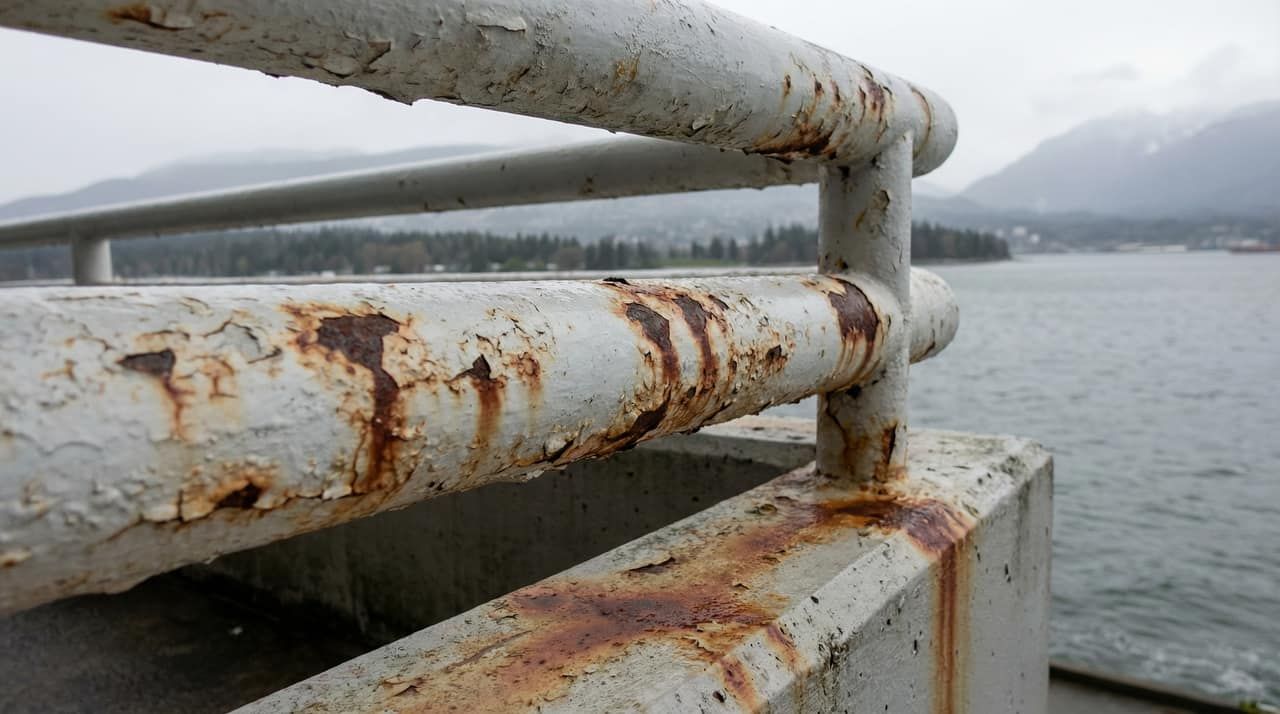
Every shop in Metro Vancouver has the same story: a homeowner calls about a steel railing they had installed eight years ago on a North Shore deck, and now there’s rust bleed dripping down the stucco. The railing was powder-coated in a matte black that looked great on day one. Nobody told them it was the wrong finish for a property within sight of Burrard Inlet.
This is the conversation our shop has every week with architects and homeowners building near the water. Hot-dip galvanizing, powder coating, and duplex systems each have a place. The wrong choice on a coastal Metro Vancouver project doesn’t just look bad — it can write off a custom railing system in less than a decade. Here’s how we think about the decision.
The two finishes do different jobs
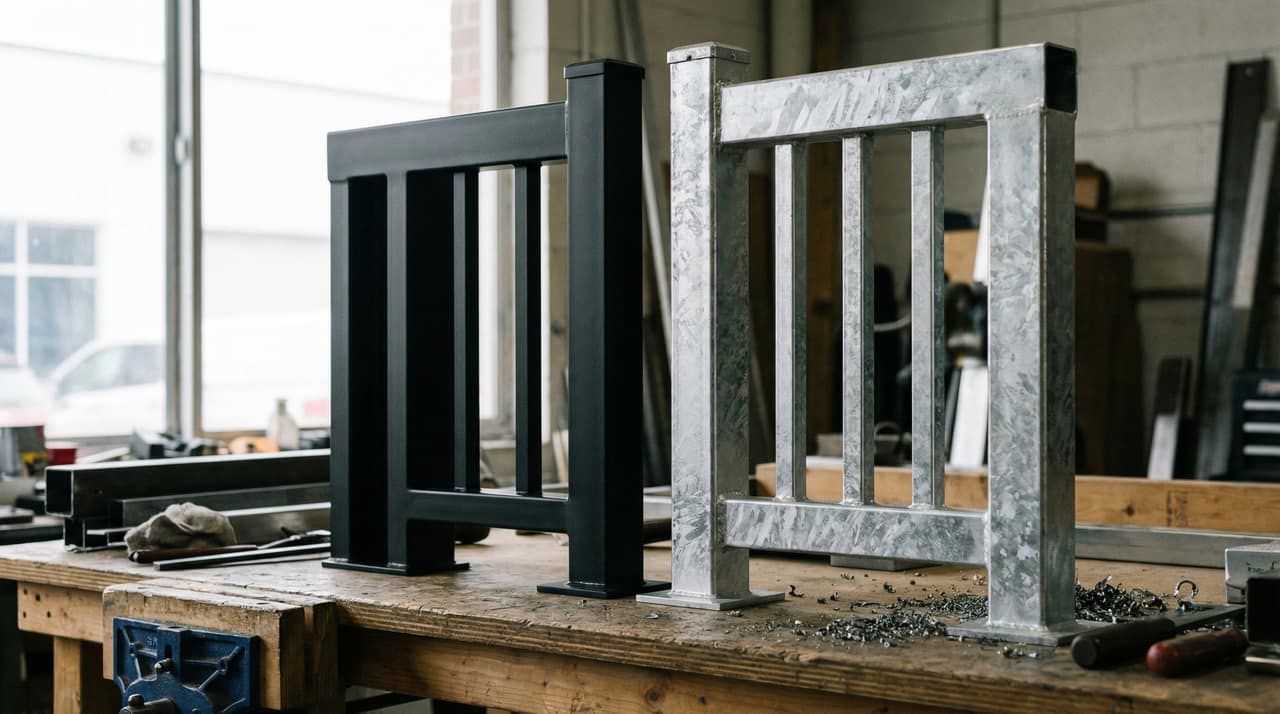
Hot-dip galvanizing and powder coating are often pitched as alternatives, but they’re solving different problems.
Hot-dip galvanizing is a metallurgical process. The fabricated steel is submerged in a bath of molten zinc at about 450°C. The zinc bonds to the steel and forms several layers of zinc-iron alloy plus a top layer of pure zinc. The protection is two-part: a barrier (the zinc layer keeps oxygen and chlorides off the steel) and a sacrificial mechanism (zinc corrodes preferentially, so if the coating is scratched, the surrounding zinc continues to protect the exposed steel until the zinc near the damage is consumed).
Powder coating is a barrier finish. Electrostatically charged dry pigment is sprayed onto clean steel and cured at around 200°C, fusing into a hard, uniform film. It holds colour beautifully and resists impact, but it’s purely a barrier — when it’s breached, the steel underneath has nothing protecting it.
That distinction is everything in a coastal environment. Salt air and salt mist accelerate corrosion several times faster than inland conditions. A barrier finish with one chip in it loses to a sacrificial coating every time.
How long each system actually lasts on the Vancouver coast
The published lifespan numbers for hot-dip galvanizing assume average exposure. The American Galvanizers Association rates galvanized coatings at 40–60 years before first maintenance in rural and suburban environments, dropping to 20–25 years in coastal and heavy industrial environments.
Metro Vancouver isn’t a uniform environment. Here’s how we think about it on a project-by-project basis:
- Inland Burnaby, New Westminster, central Vancouver, Coquitlam — relatively low salt exposure. Hot-dip galvanizing realistically lasts 35–50 years. Powder coating alone holds up well, typically 15–20 years before refinishing
- Within 1 km of the water — West Side Vancouver, parts of Port Moody, central North Vancouver — moderate marine exposure. Galvanizing 25–30 years, powder coating alone starts showing failure in 8–12 years
- Direct waterfront — West Vancouver, Ambleside, Deep Cove, Squamish waterfront, Whistler high alpine — heavy salt or de-icing exposure. Galvanizing 15–25 years; powder coating alone is unreliable past 5–8 years
- Splash zone — within 75 m of regular wave action — galvanizing rust spotting can begin in 5–7 years; this is where duplex becomes mandatory
The classic Galvanizing Industry observation: galvanized steel exposed directly to salty winds can begin showing rust within 5–7 years, while sheltered areas of the same structure often continue to perform well for an additional 15–25 years. We see exactly this pattern on West Vancouver projects — the windward face of a railing degrades while the leeward face still looks new.
Duplex systems — the actual answer for coastal projects
When we get a call from a North Vancouver or West Vancouver site, our default specification is a duplex system: hot-dip galvanize first, then a top layer of marine-grade super-durable polyester powder coat.
The math on duplex is striking. The American Galvanizers Association cites a synergy factor of 1.5 to 2.3 — the combined system lasts that much longer than the sum of the two individual systems. A 15-year powder coat over a 70-year galvanizing layer can give you 120 to 184 years of effective protection in the right conditions. Even discounted heavily for Vancouver’s coastal exposure, that’s still 30–50 years of maintenance-free service on a residential railing.
The mechanism is simple. The powder coat takes the UV and impact hits at the surface. When it eventually wears through, the galvanized layer underneath kicks in and starts protecting the steel. You essentially get two coatings working in series instead of one coating doing everything.
Where powder coat alone still makes sense
We’re not anti-powder. For most inland Metro Vancouver projects, a quality powder coat over properly prepped steel is the right answer:
- Interior staircases and railings — no moisture, no salt, no UV. Powder coat lasts the life of the building
- Burnaby and Coquitlam residential exteriors more than 5 km from the water — modest exposure, 15–20 years between maintenance cycles
- Commercial signage frames, window wall frames, canopies in central Vancouver — wind and rain but minimal salt
- Custom pieces where colour and finish quality matter more than longevity — powder coat colour fidelity and surface uniformity beats galvanizing
The other reason powder coat wins inland: galvanizing leaves a characteristic spangled grey surface that not every architect wants visible. On a duplex job, the powder coat hides the spangle entirely. On a galvanized-only job, you live with the look.
What can go wrong with duplex coating
Duplex isn’t free of risk. The main failure mode we see in shops without a tight process is outgassing — trapped air or moisture in the galvanized layer escaping during the powder cure cycle and creating pinholes or blisters in the coating. The fix is well-documented: sweep blast the galvanized surface with a fine non-metallic media to ASTM D6386 to give the powder coat a mechanical key, then bake the parts at cure temperature before applying powder to drive out moisture.
The other issue is zinc oxide bloom. Freshly galvanized steel left exposed develops a white powdery zinc oxide that ruins powder coat adhesion. Best practice is to powder coat within a few days of galvanizing or chemically passivate the surface. Any shop doing duplex coastal work needs a written prep procedure. We follow the same procedure on every duplex job that leaves our Burnaby shop.
What this means for a typical Metro Vancouver project
Working through it on a real example: a 60 ft custom steel handrail and picket system for a deck on a North Vancouver property, three blocks from the water.
- Powder coat alone — about $30–$45 per linear foot for finish. Realistic life: 8–12 years before refinishing
- Hot-dip galvanizing alone — about $25–$40 per linear foot. Realistic life: 20–25 years, but the owner lives with the spangled grey look
- Duplex (galvanize + powder coat) — about $45–$65 per linear foot. Realistic life: 30–40 years with the colour and finish quality of powder coat
Across the 60 ft railing, the duplex upgrade over plain powder coat is roughly $900–$1,500 — on a project where the railing fabrication and install is already $15,000–$25,000. That’s a 5–8% premium for triple the service life. Every coastal customer we’ve walked through this math has chosen duplex.
For inland Burnaby, Coquitlam, or central Vancouver projects, we usually still recommend a quality polyester powder coat and skip the galvanizing — the salt exposure isn’t there to justify the cost.
For more detail on how these finishes compare across all use cases, see our powder coating vs. paint vs. galvanizing overview, and the custom metal railing cost guide for how finish choice affects total project pricing. If you’re starting a coastal Metro Vancouver project, the conversation we want to have at the shop is “where exactly is the steel, and what’s it facing” — that determines everything else.

