

Metro Vancouver sits on top of one of the most seismically active zones in North America. The Cascadia subduction zone — a 1,000 km fault running from northern California to Vancouver Island — is overdue for a major event by geological standards. The last full rupture was in 1700. Seismologists at Natural Resources Canada put the probability of a magnitude 9.0+ earthquake at roughly 10–15% in the next 50 years.
That’s the backdrop for every structural steel project we fabricate from our shop in Burnaby. Seismic design isn’t an abstract engineering exercise here — it directly shapes how we detail connections, what weld procedures we use, and how much steel goes into a building frame.
Where Metro Vancouver sits on the seismic map
Under the 2020 National Building Code of Canada (NBC 2020), which BC adopted with amendments, seismic hazard is defined by spectral acceleration values at a specific site rather than the old “zone” system. But the old shorthand still gets used in conversation: Metro Vancouver lands in what used to be called Zone 4 to 5, depending on soil conditions.
The numbers that actually drive design are the spectral response accelerations — Sa(0.2), Sa(0.5), Sa(1.0), and Sa(2.0) — and the peak ground acceleration (PGA). For a Site Class C location in central Burnaby, the PGA is around 0.40g. Move to the Fraser River delta soils in Richmond or parts of south Vancouver — Site Class D or E — and those values climb because soft soils amplify ground motion.
What this means in practice: the structural engineer sizes every beam, column, and connection in a Metro Vancouver steel frame to resist lateral forces that are 2–4 times higher than what a building in, say, Winnipeg would need to handle.
How seismic requirements change the steel
A steel frame designed for gravity loads alone — just holding up floors and a roof — is a relatively straightforward fabrication scope. Add seismic requirements and the complexity increases at every level.
Moment-resisting frames vs. braced frames. These are the two primary systems for resisting lateral earthquake forces in steel buildings. A moment-resisting frame (MRF) uses rigid beam-to-column connections that can flex and absorb energy without fracturing. A braced frame uses diagonal steel members (chevron braces, X-braces, or eccentrically braced configurations) to triangulate the structure against lateral movement.
Each system has trade-offs. Moment frames give architects open floor plans with no diagonal braces blocking sightlines or doorways — popular in commercial and retail spaces around Vancouver and Coquitlam. But the connections are expensive to fabricate. A single moment connection can require full-penetration groove welds on both beam flanges, continuity plates inside the column, doubler plates on the column web, and shear tab connections — all tested and inspected to CJP (complete joint penetration) standards.
Braced frames are more cost-effective to fabricate and can handle higher seismic forces with lighter members. The trade-off is architectural: those diagonal braces show up in walls and limit where you can put windows and doors. We see a lot of concentrically braced frames on industrial buildings in Burnaby and New Westminster, and eccentrically braced frames on mid-rise commercial projects where the engineer wants the stiffness of bracing with some of the ductility of a moment frame.
Ductile design — the steel has to bend, not break. This is the core principle. In a major earthquake, a building is expected to sustain damage. The code doesn’t require a structure to survive a Cascadia-scale event without any deformation — that would be prohibitively expensive. Instead, the code requires ductile behaviour: the steel frame absorbs energy by yielding (bending permanently) at predetermined locations, while the connections and columns remain intact enough to prevent collapse.
For fabricators, this means using steel grades with guaranteed ductility (CSA G40.21 350W is the standard structural grade in Canada), designing connections so that plastic hinges form in the beams rather than the columns (the “strong column, weak beam” principle), and avoiding brittle failure modes like weld fracture or bolt shear at connections.
What the code actually requires
The BC Building Code adopts the NBC 2020 seismic provisions with some BC-specific amendments. Here’s what matters for steel fabrication.
Seismic force resisting system (SFRS) classification. The engineer selects the SFRS type — ductile moment-resisting frame, moderately ductile moment frame, limited-ductility concentrically braced frame, and so on. Each type has a ductility-related force modification factor (Rd) and an overstrength factor (Ro) that determine the design seismic forces. Higher ductility systems (Rd = 5.0 for ductile MRFs) allow lower design forces but demand more stringent connection detailing and fabrication quality.
Connection design to CSA S16. All structural steel design in Canada follows CSA S16 (Design of Steel Structures), which has an entire clause — Clause 27 — dedicated to seismic design. This clause specifies connection types, weld requirements, member proportioning limits, and testing protocols for seismic force resisting systems. The 2024 edition updated several provisions around brace connection design and composite floor interaction.
Weld procedure specifications. Demand-critical welds — the ones at moment connections and brace-to-gusset joints in seismic frames — require pre-qualified weld procedures per CSA W59. That means specific filler metals (typically E70XX or E71T-8 classifications with Charpy V-notch toughness requirements), controlled preheat temperatures, interpass temperature limits, and in some cases, weld metal with certified CVN toughness at -30C or lower.
Inspection requirements. The NBC and BC Building Code mandate third-party weld inspection on seismic connections. Full-penetration groove welds on moment connections get ultrasonic testing (UT) at a minimum. Some engineers spec radiographic testing (RT) on a percentage of CJP welds. This adds cost and schedule time, but it’s non-negotiable — an uninspected CJP weld on a moment connection won’t pass building permit review.
C.W.B. certification and seismic fabrication
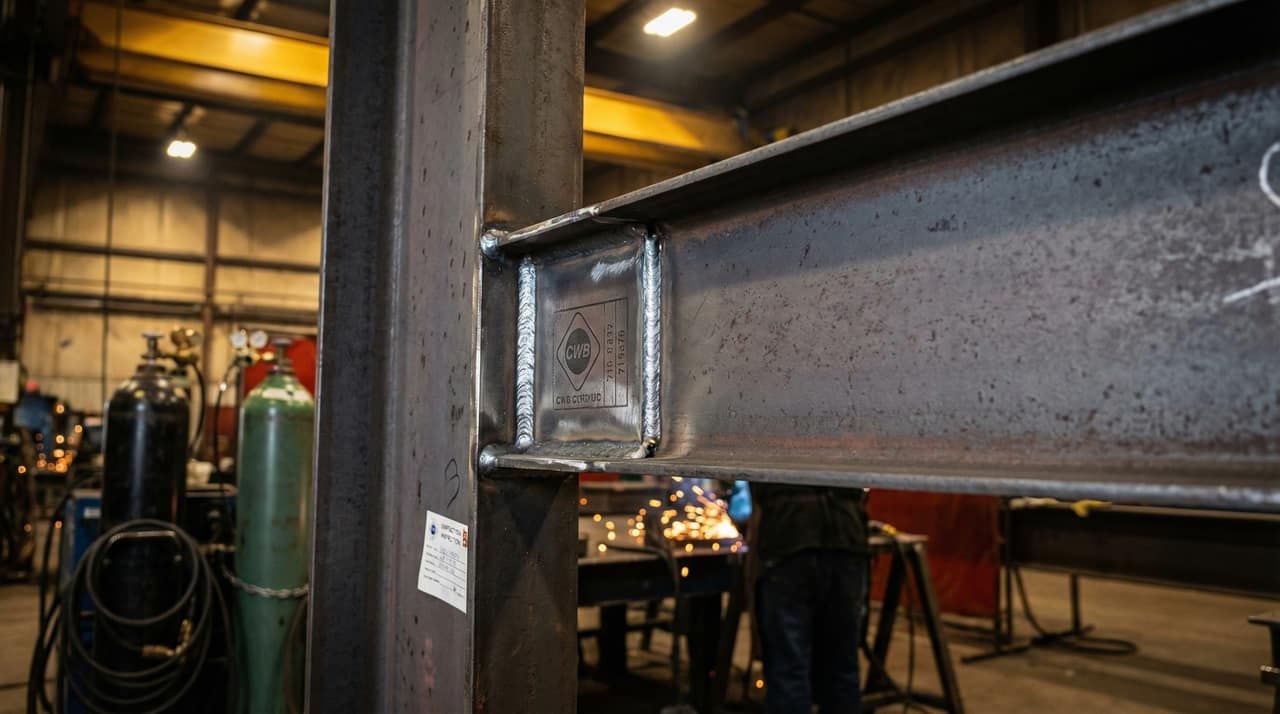
Every structural steel fabrication shop working on seismic projects in BC must hold C.W.B. certification to CSA W47.1. This isn’t a suggestion. Municipal building departments in Burnaby, Vancouver, Coquitlam, and across Metro Vancouver require the fabricator’s C.W.B. certification number on shop drawings before they’ll release a building permit for structural steel work.
The certification covers three things: the shop’s welding procedures are qualified and documented, the individual welders are tested and certified for the specific processes and positions required, and the shop has a quality control program with a designated welding supervisor or engineer.
For seismic work specifically, the C.W.B. certification matters because the weld quality requirements are significantly higher than on non-seismic steel. A fillet weld on a stair stringer connection and a full-penetration groove weld on a moment frame column flange are different universes of quality control. The C.W.B. system makes sure the shop and its welders can actually execute the latter.
We hold C.W.B. certification at our Burnaby shop and have fabricated structural steel for seismic applications on commercial, institutional, and residential projects across Metro Vancouver. The difference between a C.W.B.-certified shop running qualified procedures and an uncertified shop guessing at weld parameters shows up in weld quality — and shows up fast when the inspector arrives with an ultrasonic testing unit.
Residential seismic upgrades — the soft-storey problem
Not all seismic steel work is new construction. A large portion of the residential seismic retrofit work we see in Metro Vancouver involves older homes — particularly the 1960s through 1980s housing stock that dominates neighbourhoods across Burnaby, East Vancouver, New Westminster, and Coquitlam.
The classic problem is the “soft storey.” A two-storey house with a large garage opening on the ground floor and living space above has a weak point: that ground level has less shear resistance than the floor above it. In a strong earthquake, the ground storey collapses sideways while the upper floor drops straight down. This is the failure pattern that caused the most residential damage in the 1989 Loma Prieta earthquake in San Francisco, and the housing stock in parts of Metro Vancouver is structurally similar.
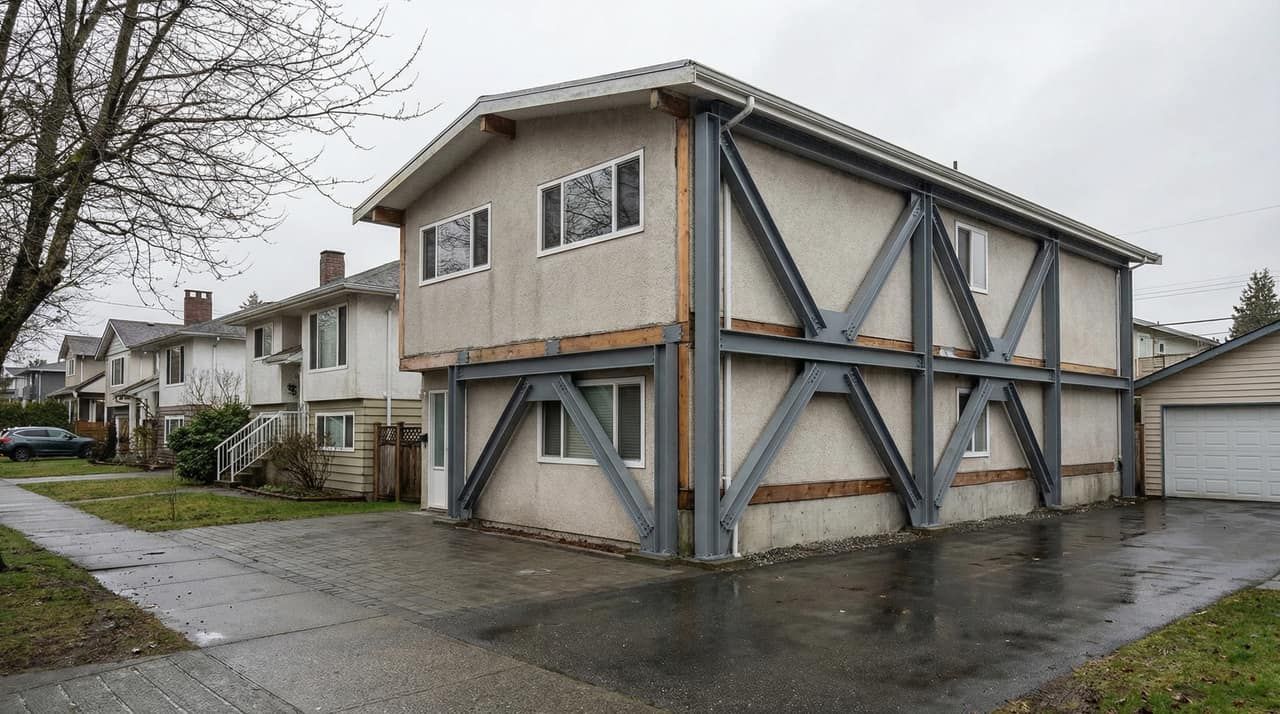
Steel braced frames are the most common retrofit solution. We fabricate chevron braces or X-braces from HSS (hollow structural section) tube steel, typically 76mm x 76mm to 152mm x 152mm depending on the engineer’s design, then bolt or weld them into the existing wood frame at the ground storey. The bracing transfers lateral loads directly to the foundation, stiffening the weak storey and preventing the collapse mechanism.
A typical residential seismic retrofit scope runs $25,000–$60,000 for a single-family home. The variance is wide because it depends on the number of braced bays required, the foundation condition (some older homes need foundation upgrades before the steel can be attached), and how much finishing work needs to be redone after the steel goes in.
The City of Vancouver has run seismic retrofit incentive programs periodically, and several Metro Vancouver municipalities have flagged soft-storey buildings in their seismic risk assessments. If you own a pre-1990 house with a tuck-under garage, a structural engineer’s assessment is worth the $2,000–$4,000 investment — the retrofit cost is a fraction of the potential loss.
Commercial and mid-rise seismic steel
On commercial projects — the 3 to 6 storey mixed-use buildings going up all over Burnaby, Coquitlam, and the Broadway corridor in Vancouver — seismic requirements shape the entire structural concept from the earliest design stages.
The structural engineer selects the SFRS type based on building height, floor plate dimensions, site soil class, and architectural constraints. A 4-storey office building on firm ground in North Burnaby might use a moderately ductile concentrically braced frame with Rd = 3.0. A 6-storey mixed-use building on softer soil near the Fraser River might need a ductile moment-resisting frame with Rd = 5.0 to stay within the code’s drift limits.
For the fabricator, the SFRS type determines everything: connection details, weld volumes, inspection requirements, and schedule. A braced frame package with gusset plate connections is faster to fabricate than a moment frame package with full-penetration beam-flange welds, but both need to meet the same code performance targets.
We typically work from the structural engineer’s design drawings, produce detailed shop drawings with all connection geometry and weld callouts, then submit those for the engineer’s review and stamp before cutting any steel. On seismic projects, the shop drawing review cycle is longer and more detailed — engineers check every connection against the CSA S16 Clause 27 requirements, and anything that doesn’t comply gets sent back for revision.
What seismic design adds to the cost
Seismic detailing adds cost. There’s no way around it. Here’s where the money goes.
Heavier connections. Moment connections use thicker flange plates, continuity plates, and doubler plates than gravity-only connections. A simple shear tab connection might use a 10mm plate and six bolts. The moment connection on the same beam-to-column joint uses full-penetration groove welds, 20–25mm continuity plates, and possibly a 16mm doubler plate on the column web. More steel, more welding, more inspection.
Full-penetration welds instead of fillet welds. A CJP groove weld takes 3–5 times longer to execute than a fillet weld of comparable size. It requires joint preparation (beveling the beam flanges), backing bars or backgouging, and careful multi-pass welding with controlled interpass temperatures. Each one then gets ultrasonic testing by a certified inspector.
Third-party inspection. UT inspection on CJP welds runs $150–$300 per joint depending on the inspector and the access conditions. On a project with 40–60 moment connections, that’s $6,000–$18,000 in inspection costs alone.
Design iteration. Seismic steel packages go through more shop drawing review cycles. The engineer scrutinizes connection geometry, weld sizes, bolt patterns, and member sizing against the seismic provisions. Revisions are common, and each revision cycle adds a week or more to the schedule.
On a typical 3,000–5,000 sq ft commercial structural steel package in Metro Vancouver, seismic detailing adds roughly 10–25% to the fabrication cost compared to the same building designed without seismic requirements. For a steel package that would cost $120,000–$180,000 in a low-seismic zone, the same scope in Burnaby or Vancouver runs $140,000–$220,000 once seismic connections, heavier members, and inspection are factored in.
The Cascadia factor
The Cascadia subduction zone makes BC’s seismic requirements different from most of the rest of Canada. It’s not just the peak ground acceleration values — it’s the duration. A subduction zone earthquake produces long-duration shaking, potentially 3–5 minutes of strong ground motion compared to 15–30 seconds from a shallow crustal earthquake.
Long-duration shaking matters for steel structures because it increases the number of inelastic cycles the connections must endure. A moment connection that can handle 10 cycles of plastic rotation might fail at cycle 30. The NBC 2020 seismic provisions account for this through the spectral shape and the design methodology, but it’s worth understanding why BC’s requirements exist at the level they do.
The 2024 updates to the National Building Code (which BC is in the process of adopting) revised some spectral acceleration values based on updated seismic hazard models and adjusted provisions for near-fault effects — relevant for sites close to crustal faults in the North Shore mountains and through the Fraser Valley.
What this means for your project
If you’re building in Metro Vancouver, seismic requirements will affect your structural steel scope whether the project is a new commercial building, a residential addition, or a retrofit of an existing structure. The cost premium is real but manageable — and it’s not optional.
The fabricator you choose matters. C.W.B. certification is the minimum. Beyond that, look for a shop with experience producing seismic connection packages, familiarity with CSA S16 Clause 27 detailing, and a track record of clean third-party inspection results. A shop that struggles with basic CJP weld quality will burn your schedule and your budget on rework and re-inspection.
We fabricate seismic structural steel at our Burnaby shop and have worked on projects ranging from single-family soft-storey retrofits to multi-storey commercial frames across Metro Vancouver. If you have a project with seismic steel requirements — or you’re not sure whether your existing building needs a seismic assessment — get in touch with our team or request a quote and we’ll walk through the scope with you.

