

The custom driveway gate conversation usually starts with the look the owner wants and ends with the constraints of the driveway. Most of the interesting decisions — swing vs. slide, manual vs. automated, what operator to spec, how deep the footings go — aren’t about style at all. They’re about the geometry of the driveway, the grade, the wind exposure, and what happens when the power’s out in a Squamish windstorm.
Here’s how a custom driveway gate actually gets scoped for a Metro Vancouver property in 2026, with real numbers and the trade-offs we walk clients through at our Burnaby shop.
Swing vs. slide — what actually drives the decision
The single biggest factor is driveway depth. A double swing gate needs behind-the-gate clearance equal to the length of one leaf plus a little margin. For a 10 ft opening, each leaf is 5 ft, and the gate needs at least 5.5 ft of unobstructed driveway behind the gate line before it hits a car, a parking pad, or a structure. On a deep West Vancouver estate driveway, that’s not a constraint. On a tight Kitsilano or East Vancouver lot where the driveway is 20 ft long and the garage door is at the back, it’s a dealbreaker — a swing gate would hit a parked vehicle, and a slide gate is the only option.
The other big factor is grade. Swing gates handle slopes well because the leaf arcs through space; as long as the hinges are level with each other, the gate can swing on any grade. Slide gates need a level runway along the driveway — either a V-track or a cantilever runway — and they struggle with slopes above about 2% unless you engineer a hinged runway system, which adds cost.
The third factor is how much room you have to the side. A slide gate needs an equal length of open runway alongside the driveway to receive the gate leaf when open. A 12 ft opening needs 12+ ft of clear sideyard for the cantilever counterweight arm. Narrow Vancouver lots often don’t have it.
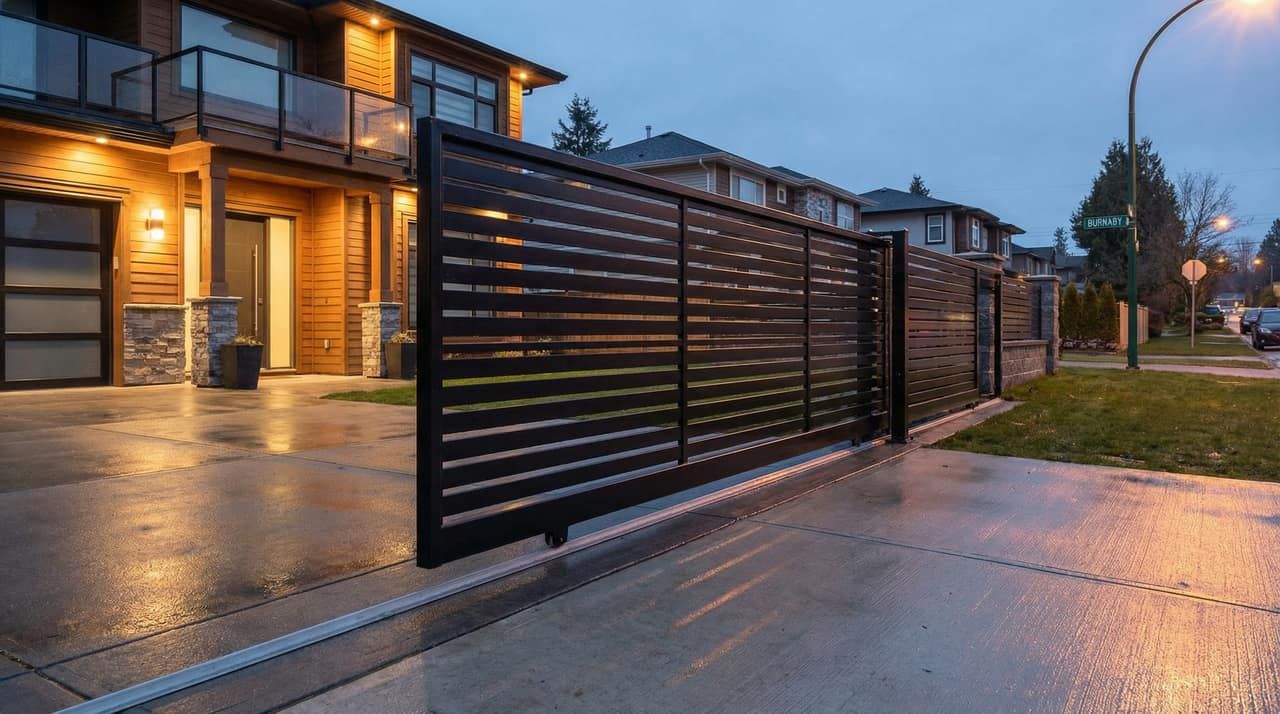
Our rough rule of thumb on a Metro Vancouver project: swing gate first, slide gate only when the driveway geometry forces it. About 70% of our residential driveway gate installs end up swing; the rest are cantilever slides.
What automation actually adds
The operator is where a custom gate goes from a hand-pushed entrance to an everyday convenience, and it’s also where the electrical and code complexity shows up.
Operator types:
- Linear arm (ram) operators — the workhorse for residential swing gates. An electric ram mounted between the pillar and the leaf pushes the gate open and closed. Simple, reliable, 15+ year service life with basic maintenance
- Underground hydraulic operators — hidden in a box cast into the driveway surface. Cleaner look, higher cost, more sensitive to drainage issues in Metro Vancouver’s wet climate
- Articulated arm operators — for swing gates where a straight ram would hit the pillar. More moving parts, slightly less reliable
- Slide gate operators — rack-and-pinion or chain drive, mounted beside the track. Purpose-built for cantilever slides
Every powered gate in BC has to meet UL 325 entrapment protection standards. That means primary and secondary sensors on each direction of travel — typically photo eyes at the gate pillars plus safety edges on the leading edge of the gate. The operator has to reverse on obstruction within 2 seconds. Technical Safety BC enforces this on inspection.
Access control options, 2026:
- Keypad with rolling code — basic, reliable, $200–$500
- Cellular intercom with video — modern default for most estates, $800–$1,800
- App-based smart access (like mvi, OpenPath, or Gate FX integrated products) — $1,200–$2,500
- Facial recognition and license plate reader — premium estates, $3,000+
The total cost delta for adding full automation to a custom swing gate is usually $3,000–$6,000 at the mid tier.
Real 2026 pricing
Numbers from recent Metro Vancouver projects:
- Manual swing driveway gate, 10 ft opening, welded steel with basic powder coat — $5,500–$8,500 installed
- Automated swing driveway gate, 10–12 ft opening, welded steel, mid-tier operator, keypad entry — $9,500–$14,500 installed
- Automated cantilever slide gate, 14 ft opening, welded steel, rack drive operator, smart access — $14,000–$22,000 installed
- Estate swing gate, 16 ft+ opening, forged detail, duplex finish, premium underground operator, camera + intercom — $22,000–$45,000+ installed
- Heritage restoration gate with automation retrofit in Shaughnessy — custom quoted, typically $25,000–$60,000
The numbers that throw off a lot of budgets aren’t the gate itself but the site work: footings in difficult soil, electrical run from the house to the gate pillars (often $1,500–$4,000 alone on a long driveway), and drainage around underground operators in Metro Vancouver’s wet ground.
Footings, wind loads, and the parts people forget
A 12 ft wide double swing gate with solid steel infill is a sail in a windstorm. On a North Vancouver or Squamish site, the wind loads on the gate leaves transfer into the hinge pillars, which transfer into the footings. Get this wrong and the pillars rotate in the ground within a year.
Our default footing spec for a residential custom steel driveway gate:
- Standard Metro Vancouver conditions — 450 mm (18 in) diameter reinforced concrete footing, 1.2 m (4 ft) deep, with rebar cage tied to the embedded pillar base plate
- Wind-exposed North Shore or Sea-to-Sky — 600 mm (24 in) diameter, 1.5–2 m (5–6.5 ft) deep, with stiffer pillar sections
- Soft or expansive soils — engineered footing, often with a helical pile underpinning or widened pad footing
On a slide gate, the footings sit under the runway rather than at pillars, but the counterweight arm of a cantilever slide creates its own loading pattern that needs to be engineered.
What we need at the first meeting
When a client calls about a custom driveway gate, the conversation at our Burnaby shop usually starts with photos and basic driveway measurements. What moves the project from quote to build:
- Driveway width at the gate line — determines leaf sizing
- Depth of driveway behind the gate line — determines swing vs. slide
- Grade of the driveway — affects operator type and hinge geometry
- Power source and panel location — hardwired operator vs. solar/battery
- Wind exposure category — affects pillar and footing sizing
- Permit status — see our Vancouver permits for railings, gates, and fences breakdown
- Design language — forged, modern, heritage, minimalist — informs fabrication approach (see forged vs. welded ironwork)
With those answers locked, we can usually deliver a realistic fixed quote and a lead time within 48 hours. The worst outcomes we’ve seen on driveway gates are the ones where the fabrication was great but the site constraints weren’t checked first. Measure twice, cut once applies to gates even more than railings.
For more on custom gate fabrication generally, see our custom metal gates in Vancouver overview. If you’re scoping a driveway gate project for a Metro Vancouver property, the Burnaby shop is the right place to start the conversation — bring the driveway photos and a rough sketch, and we’ll walk you through the trade-offs in half an hour.

